How to Get Into Oxford as an International Student: Undergraduate Acceptance Rate, Requirements, Fees and Deadlines
Reviewed by the Anywhere Uni admissions team on November 2026.
Em resumo
- Oxford acceptance rate for international students: 7.7% of applicants from outside the UK were admitted in 2025, against 14.2% of all applicants.
- Oxford or Cambridge, not both: you cannot apply to Oxford and Cambridge in the same year, so you have to choose one.
- Application deadline: October 15, 2026, 6pm UK time, via UCAS, for fall 2027 entry.
- Admissions tests: course-dependent. ESAT, TMUA or TARA for most tested subjects, UCAT for Medicine, LNAT for Law; many courses require no test.
- English requirement: IELTS 7.5 overall with at least 7.0 in each component, or an equivalent test.
- Total cost: approx. £162,000 ($216,400) for a three-year degree at the lowest fee band, including tuition, nine months of living costs per year, the visa and the health surcharge.
- This article is for you if you are a student outside the UK seriously considering an Oxford undergraduate degree and want the full picture, from acceptance rate and qualifications to tests, fees and deadlines.
Introdução
The University of Oxford assesses international applicants on exactly the same criteria as UK students, with no quota on any course except Medicine, and 21% of its undergraduates are international students. What changes for you is the size of the pool you compete in and the number of steps that depend on your own curriculum: which grades Oxford reads in your national diploma, which tests your course sets, when your final results come out.
Getting into Oxford comes down to three things that this guide covers in order: meeting the academic bar for your course (grades, admissions test, English), navigating a calendar that starts earlier than anywhere else in the UK, and showing, in your personal statement and at interview, a depth of engagement with your subject that goes well beyond the school syllabus.
How Does Oxford Compare With Cambridge, Imperial, LSE and UCL?
The table compares Oxford with the four UK universities international applicants most often weigh it against. Figures are for undergraduate entry.
| Universidade | Offer rate, all applicants | Typical A-level offer | Typical IB offer | Annual tuition, overseas students | Applications and admissions | QS World Rankings universitários 2027 |
|---|---|---|---|---|---|---|
| Universidade de Oxford | 17% | AAA to A*A*A | 38 to 40 points | £39,620 to £66,580 ($52,900 to $89,000), clinical Medicine higher | 23,329 applications, 3,302 admitted (2025) | 4th |
| Universidade de Cambridge | 22% | A*AA to A*A*A | 41 to 42 points | £29,052 to £70,554 ($38,800 to $94,300) | 22,513 applications, 3,669 admitted (2025) | 6th |
| Imperial College de Londres | 24% | A*A*A to A*A*A* | 39 to 42 points | £42,700 to £58,600 ($57,100 to $78,300) | 33,923 applications, 3,627 admitted (2025) | 2nd |
| LSE | 16% | AAB to A*AA | 37 to 39 points | £28,900 to £39,900 ($38,600 to $53,300) | approx. 34,000 applications for 1,900 places (2026) | 62nd |
| UCL | 30% | ABB to A*A*A | 34 to 40 points | £29,500 to £57,300 ($39,400 to $76,600) | Não publicado | 8th |
Methodology. Offer rates are the share of all applicants (UK and international) receiving an offer, not a rate specific to international students. Oxford, Cambridge and Imperial figures are for the 2025 admissions cycle (Oxford Annual Admissions Statistical Report 2026, Cambridge Undergraduate Admissions Statistics 2025 cycle, Imperial Undergraduate Admissions Statistics 2021-2025); LSE figures are for 2026; UCL does not publish its application and admission numbers. Typical offers are standard (non-contextual) offers across each university’s undergraduate courses, taken from official course pages. Tuition fees are annual overseas rates: Oxford and Cambridge for 2027 entry, Imperial for 2026 entry, LSE and UCL for 2026-27. For Cambridge, Imperial, LSE and UCL, clinical Medicine sits at the top of the range. Dollar equivalents use the Bank of England spot rate of October 22, 2026 (GBP/USD 1.3363), rounded to the nearest $100. QS ranks come from the QS World University Rankings 2027, published in June 2026, and are one indicator among others, not the basis of this comparison.
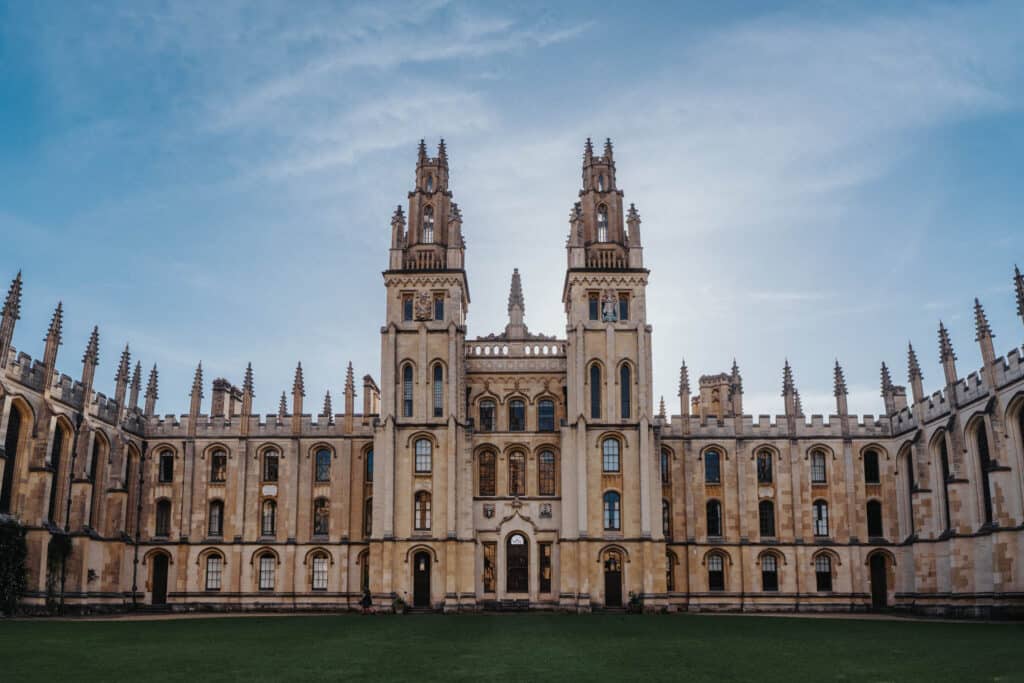
Oxford describes itself as the oldest university in the English-speaking world: there is no clear date of foundation, but teaching existed there in some form in 1096. It is organized around 36 colleges and three societies. You do not simply enroll in a department: you belong to a college, which becomes your home, your community and the place where much of your teaching happens through the tutorial system. A tutorial normally brings together two or three students and their tutor to discuss your work in depth and give you individual feedback, alongside the lectures, seminars, lab work or language classes of your course.
Oxford is ranked 4th worldwide in the QS World University Rankings 2027, 1st in the world for Arts and Humanities in the QS World University Rankings by Subject 2026, and was named the world’s number one university by Times Higher Education for a tenth consecutive year in 2025. If you want to understand what those positions measure and what they leave out, read our guide to the QS World University Rankings 2027 explained.
What Is Oxford’s Acceptance Rate for International Students?
Oxford admitted 7.7% of its applicants from outside the UK in 2025, against 18.2% of UK applicants. The gap between the offer rate and the admission rate in the table below is made up of offer holders who did not meet their conditions or chose another university. All figures in this section come from Oxford’s Annual Admissions Statistical Report 2026, which covers the 2021 to 2025 admission cycles.
| Domicile (2025 entry) | Applications | Offers | Students admitted | Offer rate | Admission rate | Share of applicants | Share of admitted students |
|---|---|---|---|---|---|---|---|
| UK | 14,340 | 3,006 | 2,609 | 21.0% | 18.2% | 61.5% | 79.0% |
| EU | 1,389 | 101 | 82 | 7.3% | 5.9% | 6.0% | 2.5% |
| Non-EU | 7,600 | 784 | 611 | 10.3% | 8.0% | 32.6% | 18.5% |
| All applicants | 23,329 | 3,891 | 3,302 | 16.7% | 14.2% | 100% | 100% |
Offer and admission rates calculated by Elite from Tables 1.1 and 1.3 of the report. “Outside the UK” combines EU and non-EU applicants: 8,989 applications, 885 offers (9.8%), 693 students admitted.
The report states plainly that UK-domiciled applicants are substantially more likely to receive an offer than students from outside the UK. The balance is moving, though: since 2021, the share of admitted students from non-EU countries has risen from 14.5% to 18.5%, while the share of EU applicants has fallen from 8.8% to 6.0%, and 2025 was the year non-EU applications grew again. None of this reflects a quota: Oxford does not operate quotas or targets around the nationality or domicile of admitted students, with the single exception of Medicine, where a government restriction caps the number of students with international fee status admitted each year. You are assessed against the same criteria as a domestic applicant, but you compete in a pool where a smaller share of applicants meets them.
Where do successful international applicants to Oxford come from? Over 2023 to 2025, China sent the most overseas applications and the most admitted students, but the best odds belonged to Singapore and Hong Kong, while applicants from India succeeded about once in 25 attempts (Elite calculations from Table 1.4 of the report).
| Country or region of domicile | Applications (2023 to 2025) | Students admitted (2023 to 2025) | Implied success rate |
|---|---|---|---|
| China | 6,025 | 559 | 9.3% |
| Estados Unidos | 2,891 | 202 | 7.0% |
| Singapura | 1,821 | 252 | 13.8% |
| Índia | 1,719 | 70 | 4.1% |
| Hong Kong | 1,267 | 150 | 11.8% |
| Canadá | 864 | 52 | 6.0% |
| Alemanha | 752 | 51 | 6.8% |
| Malaysia | 593 | 37 | 6.2% |
| França | 560 | 40 | 7.1% |
The headline rate also hides large differences between courses. Over 2023 to 2025, the most oversubscribed of Oxford’s 25 largest courses were Economics and Management (18.8 applicants per place), Computer Science (14.8), Biomedical Sciences (12.0), Mathematics (10.4), Mathematics and Computer Science (10.3), Law (10.0, including Law with Law Studies in Europe), Medicine (9.4), Physics (9.0), Biochemistry (9.0) and Experimental Psychology (8.6). Courses outside this list, notably in the humanities and languages, are less competitive, and the report is worth checking for your own subject before you choose.
In the comparison table above, only LSE has a lower offer rate than Oxford. For a wider view of where Oxford sits, look at how it compares with the hardest universities to get into in the world.
✦ A minha caixa de ferramentas ELITE
VÁ MAIS LONGE COM O MY ELITE

Simulador de admissão
Quais são as tuas hipóteses
de seres admitido?

Encontre o que melhor se adequa a si
Faça o nosso teste de orientação profissional «
», que demora 5 minutos

Assistente de carta de motivação
Criado com IA para que o seu
Candidatura se destaque

Criador de CV
Um modelo profissional
adaptado à sua escola de destino
Oxford Admission Requirements for International Students
Oxford’s admission requirements go well beyond strong grades. Tutors assess applications against the selection criteria of each course, and besides academic ability and potential they look for a deep interest in the subject you are applying to study. What that means for your personal statement is covered in the section on how to stand out.
What A-level, IB or Other Grades Does Oxford Require?
Your secondary school qualifications must meet Oxford’s entry requirements for your course, and Oxford accepts a wide range of international qualifications. Every course offer falls into one of three A-level bands, shown in the table below: humanities, languages and social sciences such as History, Law or PPE sit in the lowest band, most sciences such as Biochemistry, Computer Science, Medicine or Physics in the middle one, and Chemistry, Engineering Science, Mathematics and its joint courses in the highest. For each country, Oxford publishes the grades that match each band. The table translates the three bands for the main qualifications held by non-UK applicants (source: Oxford, International qualifications and summary table of admissions requirements).
| Qualification | Courses requiring AAA | Courses requiring A*AA | Courses requiring A*A*A | Notas |
|---|---|---|---|---|
| A-levels (UK and international) | AAA | A*AA | A*A*A | Subjects specified by the course |
| Baccalaureato Internacional | 38 points | 39 points | 40 points | Including core points, with 6s and 7s in subjects taken at Higher Level |
| French Baccalauréat général | Overall score of at least 15 (BFI: at least 14) | Overall score of at least 16 (BFI: at least 14) | Overall score of at least 16.5 (BFI: at least 15) | Required subjects taken as spécialités, with at least 15 where an A is required and at least 16 where an A* is required |
| German Abitur | Overall grade 1.3 | Overall grade 1.2 | Overall grade 1.1 | Required subjects at higher level (Leistungsfach, eA) where available; 13 points for an A equivalent, 14 for an A* |
| US Advanced Placement with SAT or ACT | Four APs at grade 5, or three APs at grade 5 plus SAT 1460 or ACT 31 | Four APs at grade 5, or three APs at grade 5 plus SAT 1470 or ACT 32 | Four APs at grade 5, or three APs at grade 5 plus SAT 1480 or ACT 33 | APs must include the subjects required by the course; Calculus AB and BC count as one subject; the optional essay is not required; associate degrees, CLEP, GED and dual enrollment are not accepted |
| India, CBSE (Class XII) | A1 A1 A2 A2 A2 | A1 A1 A1 A2 A2 | A1 A1 A1 A1 A2 | A1 in any subject relevant to the course |
| India, CISCE (ISC, Class XII) | Overall 90%, with 95% or above in two subjects and 85% or above in the other three | Overall 90%, with 95% or above in three subjects and 85% or above in the other two | Overall 90%, with 95% or above in four subjects and 85% or above in the fifth | Subjects relevant to the course among those at 95%; state boards, NIOS, NEET and JEE are not accepted |
The band is a minimum, and a deceptive one. Among UK-domiciled students admitted in 2025, 87.2% had achieved A*AA or better and 47.1% had achieved A*A*A or better, according to Oxford’s Annual Admissions Statistical Report 2026. International applicants should aim for the equivalent of the top of the range, not the band itself. Because requirements vary by country and by course, always check that your exact qualification is accepted on Oxford’s international qualifications page: many national diplomas are not accepted on their own, and discovering this after submitting your application leaves you with no options.
If you sit the SAT or ACT, two Oxford rules catch many applicants out. Oxford does not superscore: your SAT total must come from a single session, and for the ACT only the highest full-battery score counts. And you must enter every score you have, with its date, on your UCAS application, including tests you plan to take before the end of your final year; AP scores you have cancelled or withdrawn must be declared too, and failing to declare a qualification can lead Oxford to withdraw an offer.
Choosing Your Course at Application
Oxford offers nearly 50 undergraduate degree courses across the humanities, social sciences, natural sciences, mathematics, medicine and engineering, all taught in English. Courses last three or four years; subjects such as Engineering, Physics, Chemistry, Mathematics or Biochemistry lead to a four-year integrated master’s.
You apply for one specific course, which is a very different model from American universities, where you declare a major later. Some courses are joint honours, combining two disciplines (for example History and Politics, or Mathematics and Philosophy), and you can only apply for combinations that Oxford lists as joint courses.
Which Oxford Courses Require an Admissions Test?
Some Oxford courses require an admissions test. From 2026 entry, Oxford moved to the UAT-UK assessments, three computer-based tests delivered at Pearson VUE test centers worldwide, alongside the existing UCAT and LNAT.
| Teste | Courses | Delivered by |
|---|---|---|
| ESAT | Biomedical Sciences, Engineering Science, Physics, Physics and Philosophy | UAT-UK, Pearson VUE centers |
| TMUA | Computer Science, Computer Science and Philosophy, Mathematics, Mathematics and Statistics, Mathematics and Computer Science, Mathematics and Philosophy (the MAT is no longer used) | UAT-UK, Pearson VUE centers |
| TARA | Economics and Management; History and Economics; History and Politics; Human Sciences; Philosophy, Politics and Economics; Experimental Psychology; Psychology, Philosophy and Linguistics | UAT-UK, Pearson VUE centers |
| UCAT | Medicine | UCAT Consortium, Pearson VUE centers |
| LNAT | Law, Law with Law Studies in Europe | LNAT Consortium, Pearson VUE centers |
| No test | All other courses, including Biology, Chemistry, Materials Science, History, English, Classics and Modern Languages |
Booking deadlines and test dates are given in steps 3 and 5 of the application process below. Oxford directs candidates to the free official preparation resources published by UAT-UK, and test scores are transferred directly to Oxford. Always confirm the current requirement on your course page, since the list of tested courses can change from one cycle to the next. Our guide to admissions tests for international students compares formats and costs.
What English Test Score Does Oxford Require?
You do not need to provide evidence of your English language proficiency when you apply: if you receive an offer, you must show the required level by July 31 of the year you receive it, even if your course starts the following year.
For IELTS, the minimum is 7.5 overall, with at least 7.0 in each component (Reading, Writing, Listening and Speaking). Oxford recommends IELTS Academic and does not accept IELTS Online. It also accepts C1 Advanced and C2 Proficiency (191 overall, 185 per component), Pearson PTE Academic (76, with 66 in each skill) and the Oxford Test of English Advanced, among others. TOEFL needs particular care: Oxford accepts TOEFL iBT results (110 overall, with minimum component scores) only for tests taken up to January 20, 2026, and tests taken since the new format was introduced on January 21, 2026 do not meet the condition while the university reviews them. All four component scores must come from the same test session, as Oxford does not consider scores combined from several sittings. If you are still deciding which test to take, our comparison of IELTS or TOEFL for UK universities covers formats, costs and score equivalences.
You do not need to prove your English if your first language is English and you have always been a resident and citizen of a majority English-speaking country recognized by UK Visas and Immigration. Exemptions are also considered for students taking the International Baccalaureate in English, students taking the Singapore Integrated Programme, and students educated full-time in English for at least the two most recent years before applying who stay in English-medium education until the end of school. To request one, send Oxford’s waiver form to the college that made your offer. Once you meet the requirement, Oxford vouches for your English on your CAS, so you do not need a separate English test for the Student visa.
What Documents Do You Need at Each Stage?
The documents required when you apply are deliberately light: you self-report your qualifications and grades on UCAS rather than submitting certificates.
| Stage | Documents |
|---|---|
| At application | UCAS application, including your personal statement and your referee’s report with predicted or achieved grades; admissions test score, transferred directly to Oxford; any written work required by your course, sent to your college with its cover sheet |
| If you receive an offer | Official transcripts or certificates proving your final grades; evidence of English proficiency (if required); a Financial Declaration confirming you can meet the costs of studying and living in Oxford |
| For a UK Student visa | Your CAS (Confirmation of Acceptance for Studies) from Oxford and the immigration documents required for the UK Student visa |
How to Apply to Oxford: Step by Step
The Oxford application process runs in a fixed sequence, and two of its steps (test registration and the UCAS form) close in the fall, long before most UK universities stop accepting applications.
Step 1, spring to summer 2026: choose your course. Read the official course page, confirm that your qualifications meet the entry requirements, and check whether your course sets an admissions test or asks for written work. If you were also considering Cambridge, this is the moment to decide between the two (see the FAQ below), based on which one offers the course that suits you best.
Step 2, summer 2026: choose a college or apply open. You can state a preference for a specific college or submit an open application, in which case Oxford allocates you to a college with available places in your subject. If you have a strong reason to prefer a particular college (facilities, location, atmosphere), stating a preference makes sense; otherwise, an open application is a perfectly reasonable choice.
Step 3, by mid-to-late September 2026: register for your admissions test. This is the step most often missed, because test registration closes before the UCAS deadline. For the UAT-UK tests (ESAT, TMUA, TARA), registration opened on June 1, 2026, booking opened on July 20, and booking for the October sitting closed on September 28, 2026 at 6pm UK time (access arrangements by September 14, bursary requests by September 21). For the LNAT, applicants to Oxford had to register and book between August 1 and September 15, 2026. For the UCAT, the booking deadline was September 16, 2026. Applicants with an October UCAS deadline must take the October sitting of the UAT-UK tests; the January sitting is for applicants to the Astrophoria Foundation Year.
Step 4, before the October deadline: complete your UCAS application. All applicants apply through UCAS, and Oxford’s deadline falls several weeks before the standard UK university deadline of January 13, 2027. Your application includes your personal statement, your referee’s report with your predicted or achieved grades, and details of your qualifications, test scores and grades. How UCAS works for international applicants is worth understanding section by section before you start the form.
Step 5, October 2026: sit your admissions test. The UAT-UK tests took place from October 12 to 16, 2026, at Pearson VUE test centers, with results released to candidates on November 16. The LNAT had to be sat on or before October 15, 2026, and the last UCAT test day was September 24, 2026.
Step 6, by November 10, 2026: submit written work (if required). Some courses, mostly in the humanities, ask for one to three pieces of written work, sent to your college with Oxford’s cover sheet. Check your course page.
Step 7, December 2026: attend your interview (if shortlisted). Oxford shortlists about 10,000 candidates each year; if you are not shortlisted, your application has not been successful. Shortlisting starts at the end of November, and shortlisted applicants are invited to online interviews in early to mid-December. You can take them at school, at home or in a similar environment where you have reliable access to the technology required and a quiet space free from distraction. How to prepare is covered in the section on how to stand out.
Step 8, January 12, 2027: receive your decision. Most offers are conditional on specific grades in your final school examinations, and your place is confirmed once you meet those conditions.
Oxford Application Deadlines 2026-2027
Oxford has a single annual intake, starting in October, with one application window that applies to all undergraduate applicants, domestic and international alike.
| Data | What happens |
|---|---|
| June 1, 2026 | Registration opens for the UAT-UK admissions tests (ESAT, TMUA, TARA) |
| September 15, 2026 | LNAT registration and booking deadline for Oxford applicants |
| September 16, 2026 | UCAT booking deadline |
| September 28, 2026, 6pm UK time | UAT-UK booking deadline for the October sitting |
| October 12 to 16, 2026 | UAT-UK tests sat at Pearson VUE test centers |
| October 15, 2026, 6pm UK time | UCAS application deadline for Oxford (and last day to sit the LNAT) |
| November 10, 2026 | Deadline for written work (courses that require it) |
| Early to mid-December 2026 | Online interviews for shortlisted candidates |
| January 12, 2027 | Decisions released |
| Early July to August 12, 2027 | Final school results, depending on your curriculum; conditional offers confirmed or withdrawn |
| July 31, 2027 | Deadline for offer holders to provide evidence of English proficiency (if required) |
| Outubro de 2027 | Start of the academic year |
For students who need a UK Student visa, the summer is the critical period, when the visa requirements and costs, the documents, the financial evidence and the timeline all come into play.
How Much Does Oxford Cost for International Students?
For 2027 entry, Oxford’s annual course fees for overseas undergraduates range from £39,620 to £66,580 (approx. $52,900 to $89,000), depending on the subject, while clinical Medicine is charged at a significantly higher rate detailed on the Medicine course page. For reference, the 2026-27 range was £37,380 to £62,820 (approx. $50,000 to $83,900). Overseas students pay a significantly higher fee than Home students, and fees usually increase every year of the course.
Oxford’s official living costs page estimates monthly expenses for 2027-28 at between £1,475 and £2,175 (approx. $1,970 to $2,910), covering food, accommodation, personal items, social activities and study costs, and recommends budgeting over nine months to cover the holidays as well as term time. Before your place is confirmed, the Financial Declaration asks you to confirm that you can fund at least the lower amount for every year of your course.
| Rubrica de custos | Amount (GBP) | Aprox. USD | Fonte |
|---|---|---|---|
| UCAS application fee, 2027 cycle (one-off) | £34.50 | $46 | UCAS |
| Living costs over nine months, 2027-28 | £13,275 to £19,575 | $17,700 to $26,200 | University of Oxford, living costs |
| UK Student visa application (one-off) | £558 | $750 | GOV.UK |
| Immigration Health Surcharge, student rate (£776 per year, charged on the full length of the visa) | £2,716 for a three-year degree | $3,630 | GOV.UK |
| Indicative total for a three-year degree at the lowest fee band (three years of tuition, nine months of living costs per year, visa and health surcharge) | approx. £162,000 | approx. $216,400 | Calculated from the 2027 course fees above and the rows of this table, lower end of each range |
Dollar equivalents use the Bank of England spot rate of October 22, 2026 (GBP/USD 1.3363), rounded. The health surcharge covers the whole visa, including the months after the course ends, rounded up to the next half year. The indicative total uses 2027-28 fees and living costs for all three years; both usually rise each year.
Can International Undergraduates Get a Scholarship at Oxford?
Scholarships for international undergraduates are very rare in the UK, and where they exist they are usually partial. Oxford has two awards that cover the whole degree, both highly selective.
The Reach Oxford Scholarship is for nationals of countries on the OECD’s list of official development aid recipients who cannot study for a degree in their own country, show the highest academic ability and financial need, and intend to return home after their studies. It covers course fees, a grant toward living costs and one return airfare per year, for the three or four years of the course, in every subject except Medicine. Only around two or three are awarded each year, and you can apply only once you hold an Oxford offer: for 2026 entry, the deadline was February 4, 2026.
The Ellison Scholarship, funded by the Ellison Institute of Technology, offers a fully funded Oxford undergraduate degree plus internships on the institute’s projects. It is open in any subject, with particular interest in fields such as computer science, AI, economics, mathematics, engineering, biology, chemistry and medicine. Its calendar starts earlier than Oxford’s: for October 2027 entry, applications ran from May 1 to July 31, 2026, semi-finalists were selected from August to October and applied to Oxford through the normal process, and scholars are announced in March and April 2027.
Beyond these awards, some governments run undergraduate scholarship schemes for study abroad: check what exists in your country well before you apply. Our ranking of the best UK universities for international undergraduate students compares what each institution offers.
What Oxford Looks For: How to Stand Out
Tutors assess three things: your academic record, your performance in the admissions test and at interview, and the evidence of intellectual engagement in your personal statement and written work. The advice below follows what they actually evaluate.
Build your personal statement on supercurricular work. At Oxford, extracurricular activities only count when they are relevant to your course. What tutors want to see is supercurricular learning, which Oxford defines as exploring the subjects that interest you beyond what you study at school: investigating questions, encountering different perspectives, through lectures, articles, podcasts, videos or problems you have worked through. Write about two or three of these in depth rather than listing many, and make sure you know them well, since in some subjects the interview draws on your personal statement. Your referee’s report matters too: it works as the letter of recommendation for university that tutors read alongside your statement.
✦ A minha caixa de ferramentas ELITE
VÁ MAIS LONGE COM O MY ELITE
Simulador de admissão
Quais são as tuas hipóteses
de seres admitido?
Encontre o que melhor se adequa a si
Faça o nosso teste de orientação profissional «
», que demora 5 minutos
Assistente de carta de motivação
Criado com IA para que o seu
Candidatura se destaque
Criador de CV
Um modelo profissional
adaptado à sua escola de destino
Book your test early, then prepare for it seriously. The TARA, ESAT and TMUA each have distinct formats and require targeted practice with the free official resources published by UAT-UK. The UCAT requires significant time across its four sections: Verbal Reasoning, Decision Making, Quantitative Reasoning and the Situational Judgement Test. If you leave preparation until the start of your final school year, you will have only a few weeks before the test.
Treat the interview as a short tutorial. Oxford describes its interviews as focused conversations about your subject, closer to a short tutorial with someone who knows it well than to a test of what you have memorized. You may be asked to explore unfamiliar ideas, think through problems aloud or consider new perspectives, and the discussion develops from your answers. Tutors assess your academic potential and your motivation, not your manners, appearance or background, so practice reasoning aloud on material you have not seen before, and reread your personal statement and any written work you submitted.
Know when your results come out, and act quickly on your offer. The timing of your final results depends on your curriculum: IB results are released in early July, while A-level results come out on August 12, 2027. If you have met your conditions, make sure your school or exam board sends your results to UCAS without delay. If you need a visa, request your CAS and submit your visa application as soon as your offer is confirmed.
What Happens After Oxford: Careers and Post-Study Work
An Oxford undergraduate degree is a three- or four-year investment, so the outcome matters as much as the admission. Fifteen months after graduating, Oxford graduates earn a median salary of £30,000 to £57,000 depending on the subject (approx. $40,100 to $76,200), and five years after graduating the median rises to between £37,500 and £75,500 (approx. $50,100 to $100,900), according to the Graduate Outcomes survey and the Longitudinal Education Outcomes (LEO) dataset published on Discover Uni, the UK government’s course comparison site. Between 83% and 95% of graduates are in work or further study at 15 months, and between 71% and 100% of those in work hold highly skilled (professional or managerial) positions.
| Oxford course | Median salary 15 months after graduation | Median salary 5 years after graduation | In work or further study at 15 months | In highly skilled work at 15 months | Main occupations at 15 months |
|---|---|---|---|---|---|
| Economics and Management | Economics £45,000; Management £57,000 | Economics £62,000; Management £75,000 | 90% | 100% | Finance professionals 50%, business and research professionals 35% |
| Computer Science | £55,000 | £68,500 | 95% | 90% | IT professionals 75% |
| Philosophy, Politics and Economics | Economics £45,000; Politics £36,000; Philosophy £35,000 | Economics £62,000; Politics £50,500; Philosophy £50,500 | 88% | 85% | Business and research professionals 29%, finance professionals 16% |
| Mathematics | £41,500 | £60,000 | 91% | 85% | IT professionals 20%, business and research professionals 20% |
| Engineering Science | £35,500 | £60,500 | 89% | 95% | Engineering professionals 45%, IT professionals 20% |
| Law (Jurisprudence) | £32,000 | £75,500 | 85% | 80% | Legal professionals 55% |
| Medicine | Não publicado | £50,000 | Não publicado | Não publicado | Não publicado |
| Biology | £33,000 | £37,500 | 85% | 75% | Natural and social science professionals 25%, conservation and environment professionals 15% |
| History | £30,000 | £46,000 | 83% | 77% | Business and public service associate professionals 19% |
| English Language and Literature | £30,000 (language and area studies) | £39,000 (language and area studies) | 83% | 71% | Business and public service associate professionals 17% |
Source: Discover Uni, course pages for the University of Oxford, consulted November 17, 2026. Salaries are medians for all full-time Oxford courses in the subject shown. Salaries and employment at 15 months come from the Graduate Outcomes survey of students graduating in 2023-24 (2022-24 for Computer Science and History), sometimes based on fewer than 30 respondents; salaries at five years come from the LEO dataset for students graduating in 2015-17 and cover graduates working in the UK only, so international graduates who returned home are not counted. For English, Discover Uni only publishes salaries for the wider language and area studies group. Where a joint course reports its subjects separately (PPE, Economics and Management), each subject is shown. Dollar equivalents use the same exchange rate as the tables above.
Two things stand out for an international applicant. The gap between subjects is wider than the gap between universities: the five-year median in Law is double that in Biology, so the choice of subject, which Oxford asks you to make at application, is also a financial decision. And the five-year figures show the Oxford premium building over time, with Mathematics, Engineering, Economics and Computer Science all reaching £60,000 or more within five years.
For international graduates, the UK Graduate Route allows you to stay and work, or look for work, at any skill level after your degree, without a job offer or sponsor. Applications made from January 1, 2027 onward receive 18 months of leave (two years for applications made by December 31, 2026, three years for doctoral graduates). During your studies, a Student visa allows you to work up to 20 hours a week in term time and full-time during official vacations. Many Oxford graduates also continue to a master’s: if that is your plan, our guide to Oxford master’s admissions for international students covers the postgraduate route.
Perguntas Frequentes
No. You cannot apply to Oxford and Cambridge in the same year, so you have to choose one, and Oxford advises letting your course choice decide. On the numbers, Oxford is the harder of the two: its offer rate is lower (see the comparison table), and Cambridge admitted 10.7% of its applicants from outside the UK in 2025, a higher share than Oxford (see the acceptance rate section). If you are also considering London, see how to get into Imperial College London as an undergraduate.
Only when they are relevant to your course. Oxford states that extracurricular activities are not taken into account unless they help demonstrate the selection criteria of the course you are applying for. A debating trophy will not help a Chemistry application, but supercurricular work can: a science olympiad, an extended essay, online lectures or independent reading in your subject. Tutors want evidence of sustained intellectual engagement with the discipline.
Yes, but very few. The Reach Oxford Scholarship covers fees, living costs and one return flight a year for nationals of developing countries who cannot study for a degree at home, with only two or three awards a year and an application possible only after an offer. The Ellison Scholarship funds the whole degree plus internships, and its application closes on July 31 of the year before entry, before the UCAS deadline.
No. An open application means you do not name a college, and Oxford allocates you to a college with available places in your subject. Oxford states that this does not disadvantage your application in any way. Choosing a college can feel daunting when you have no connection to Oxford, so applying open is a reasonable default unless one college clearly suits you better.
Not with the diploma alone. For applicants from the United States, Oxford’s international qualifications page lists Advanced Placement exams as the accepted qualification: four APs at grade 5, or three APs at grade 5 combined with a qualifying SAT or ACT score. The APs must cover the subjects your course requires, and associate degrees, CLEP, GED and dual enrollment credits are not accepted.
International graduates who apply from January 1, 2027 onward can stay for 18 months under the Graduate Route, without a job offer or sponsor. A student entering Oxford in October 2027 and graduating in 2030 will therefore fall under the 18-month rule. You must apply from inside the UK, after your university confirms you have completed your degree and before your Student visa expires. The Graduate Route cannot be extended.
✦ A minha caixa de ferramentas ELITE
VÁ MAIS LONGE COM O MY ELITE
Simulador de admissão
Quais são as tuas hipóteses
de seres admitido?
Encontre o que melhor se adequa a si
Faça o nosso teste de orientação profissional «
», que demora 5 minutos
Assistente de carta de motivação
Criado com IA para que o seu
Candidatura se destaque
Criador de CV
Um modelo profissional
adaptado à sua escola de destino