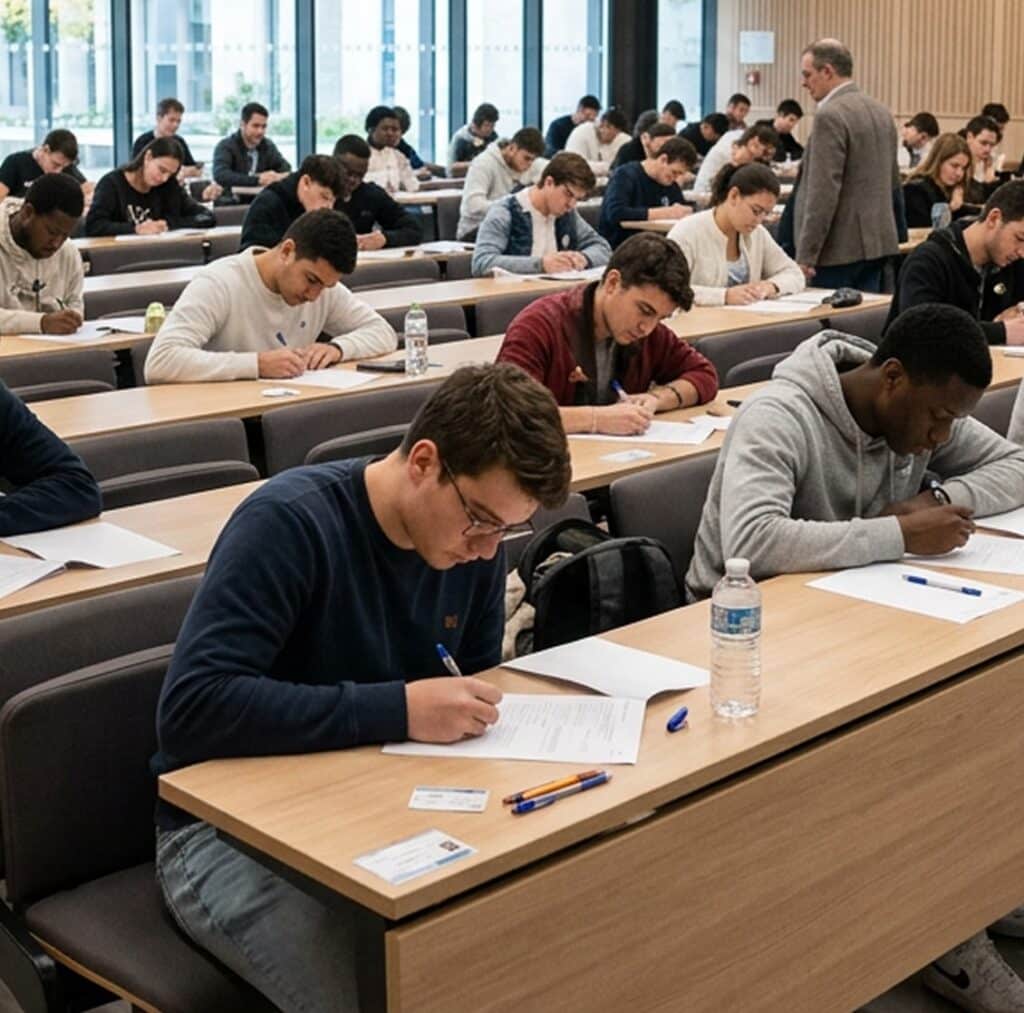

How to Get Into HEC Paris as an Undergraduate: The HEC-Bocconi Double Degree Guide for International Students
Em resumo
- Program: Bachelor of Arts and Science (BASc) in Data, Society and Organisations, a double degree run by HEC Paris and Bocconi University; graduates receive two bachelor’s degrees, a BASc from HEC Paris and a BSc in International Politics and Government from Bocconi
- Places: up to 110 per intake; the first cohort had 64 students from 31 countries
- Acceptance rate: not published by either school
- Competitive SAT: 1500+ makes an application very competitive; below 1400, admission becomes much harder (official cut-off: no score under 1040)
- Tuition: €23,000 (about $25,800) in Year 1, €75,500 (about $84,600) over three years
- Next deadline for September 2027 entry: Round II closes January 26, 2027 (Round I closed September 29, 2026)
- Location: three semesters in Milan, three semesters at HEC Paris in Jouy-en-Josas, near Paris; taught entirely in English
- This article is for you if you are in high school, you want an HEC Paris degree without going through the French preparatory classes, and you are as interested in politics, law and society as in data and AI
Introdução
High school graduates enter HEC Paris through the HEC-Bocconi double degree, the BASc in Data, Society and Organisations. Neither school publishes an HEC Paris acceptance rate for the program, but the numbers speak for themselves: up to 110 places for a global applicant pool, a selection based on Grade 10 and Grade 11 results, a standardized test, a motivational letter, a CV and a video interview. In practice, a SAT score of 1500 or more makes an application very competitive.
The program is not easier to get into than Bocconi’s own bachelor’s degrees, but it is more flexible on grades and test scores, because the committee also weighs the letter, the CV and the interview. This guide covers the HEC Paris bachelor admission requirements, the video interview, the 2027-28 deadlines, the real cost over three years and the visa steps in Italy and France, using the official HEC Paris and Bocconi pages only.
HEC-Bocconi vs. Bocconi and LUISS: How Do They Compare?
| HEC-Bocconi BASc | Bocconi BSc (direct entry) | LUISS bachelor’s | |
|---|---|---|---|
| Degree(s) awarded | Two bachelor’s degrees (HEC Paris + Bocconi) | One Bocconi BSc | One LUISS degree |
| Campus | Milan, then Jouy-en-Josas (Paris area) | Milan | Rome |
| First-year tuition, non-EU | €23,000 (about $25,800, 2026-27 rate) | €17,000 (about $19,000, 2026-27 rate) | €15,000 (about $16,800, 2027-28 rate) |
| SAT benchmark | 1500+ very competitive, under 1400 much harder | From 1480, ideally 1500+ | 1200 for direct admission |
| What is assessed | Grades, test, motivational letter, CV, video interview | Test (55%) and grades (45%) | Direct admission with SAT 1200, ACT 25 or IB 36; otherwise LUISS test |
| Application window for 2027 entry | Round II: Nov 25, 2026 to Jan 26, 2027 | Winter session: Nov 25, 2026 to Jan 26, 2027 | October 2026 to Feb 10, 2027 |
Tuition converted at 1 EUR = 1.12 USD (European Central Bank reference rate, October 2, 2026). Bocconi and HEC-Bocconi 2027-28 first-year rates were not yet published on October 5, 2026; the 2026-27 rates are shown. Sources: hec.edu, unibocconi.it, luiss.it.
The comparison shows where the double degree sits. It costs more than a Bocconi BSc and asks for a comparable SAT, but it is the only one of the three that reads your letter, your CV and your interview, which leaves room for a profile whose grades are slightly below the top of the range. If you are weighing the two Milan options, our guide on how to get into Bocconi as an undergraduate details the direct-entry route.
What Is HEC Paris’s Acceptance Rate for Undergraduates?
HEC Paris and Bocconi do not publish an acceptance rate or the number of applicants for the BASc. The only official figures are the size of the intake: Bocconi announces up to 110 places for the double degree, and HEC Paris reports that the first cohort brought together 64 students from 31 countries. HEC Paris describes the admission as selective and based on “strict academic criteria”.
What can be measured is the level expected. Bocconi rejects any application with a SAT below 1040, an ACT below 19 or an online Bocconi test below 17 out of 50, but these are floors, not targets. A SAT of 1500 or more makes your application very competitive; below 1400, it becomes a lot more difficult to get in.
✦ A minha caixa de ferramentas ELITE
VÁ MAIS LONGE COM O MY ELITE

Simulador de admissão
Quais são as tuas hipóteses
de seres admitido?

Encontre o que melhor se adequa a si
Faça o nosso teste de orientação profissional «
», que demora 5 minutos

Assistente de carta de motivação
Criado com IA para que o seu
Candidatura se destaque

Criador de CV
Um modelo profissional
adaptado à sua escola de destino
What Is the HEC-Bocconi Double Degree in Data, Society and Organisations?
The program lasts three years (180 ECTS credits) and is taught entirely in English. Students spend Year 1 and the first semester of Year 2 at Bocconi in Milan, then the second semester of Year 2 and Year 3 at HEC Paris, on its campus in Jouy-en-Josas, 20 km from Paris. Graduates leave with two bachelor’s degrees: a BASc in Data, Society and Organisations from HEC Paris and a BSc in International Politics and Government from Bocconi.
That second title matters when you decide whether to apply. On the Bocconi side, the double degree is a track of the International Politics and Government program, not of a business or economics degree. The curriculum combines data science (mathematics, coding, machine learning, AI) with the social sciences (economics, public law, political science, governance, ethics), and only adds management in the later years. A student who wants a classic business degree will be better served by a Bocconi BSc in Management or Economics; the double degree suits students who want to use data to understand institutions, public policy and organizations.
Year 1 at Bocconi covers Economics, Comparative Public Law and Regulation, Politics and Public Sector, Quantitative Methods for Social Sciences, Coding and Data Visualization in Python, Global History and Affairs and an introduction to Machine Learning. The first semester of Year 2, still in Milan, adds Deep Learning, the Governance of Digital Technologies and Social Media and Democracy. At HEC Paris, students take Business Analytics and Data Modelling, European Governance, Behavioral and Cognitive Science and the Ethics and Philosophy of AI, then choose two pathways in Year 3 among Law, Tech and Society, Governance and Public Policy, Business and Management, and Accounting and Finance. The final semester is built around a capstone project, a team data challenge run with a public or private organization, alongside a bachelor’s thesis at Bocconi and a reflective capstone paper at HEC Paris. A foreign language is part of Years 1 and 2.
HEC Paris was ranked second in the Financial Times European Business School Ranking 2025 (published December 1, 2025), and Bocconi is 12th in the world for Social Sciences and Management in the QS World University Rankings by Subject 2026. Between them, the two schools count about 207,000 alumni in 130 countries. For a broader view of joint programs like this one, see our analysis of dual degree programs, and to compare HEC Paris with other French options, our ranking of the best universities in France for international undergraduates.
HEC Paris Bachelor Admission Requirements for International Students
The HEC Paris bachelor requirements are the same for every applicant, whatever their nationality. A joint HEC Paris and Bocconi committee reviews the full file, and no specific high school subjects are mandatory.
Which High School Grades Count?
The committee reads your third-last and second-last year of high school, in other words Grade 10 and Grade 11 in a twelve-grade system (Year 11 and Year 12 in the UK system, seconde and première in the French system). Your final year is not part of the assessment, exactly as for Bocconi’s direct-entry programs. Most applicants therefore apply with a record that is already closed: a weak Grade 10 cannot be repaired by a strong senior year. If you are in Grade 10 now, that year already counts.
What SAT Score Do You Need for HEC-Bocconi?
You need one official result among the SAT, the ACT or the online Bocconi test. A SAT of 1500 or more makes your application very competitive; a score below 1400 makes it a lot more difficult to get in. The committee has a little more flexibility on grades and test scores than Bocconi’s direct-entry programs, because it also uses the letter, the CV and the interview.
You can submit both a SAT and a Bocconi test in the same round. Take the SAT for the first time in Grade 11, because you may need to retake it two or three times to reach your target, and preparation resources are plentiful (Khan Academy, the College Board’s Bluebook app). The online Bocconi test lasts 75 minutes and contains 50 multiple-choice questions: 24 in mathematics, 11 in reading comprehension, 6 in numerical reasoning and 9 in critical thinking. Wrong answers cost points (minus 0.2, or minus 0.33 on three-option critical thinking questions). It is taken at home, under audio and video recording, costs €60 (about $67) per attempt, and can be taken up to four times. It follows the Italian school curriculum and has few preparation resources, so some topics will need to be revised on your own. For a full comparison of the formats, read our guide to the SAT and other admission tests.
Which Subjects Should You Take in High School?
None is compulsory, but mathematics weighs heavily. Almost half of the Bocconi test is math, and Year 1 includes Quantitative Methods, Python and Machine Learning. Taking the highest level of mathematics available in your school is the safest choice for this program.
English Language Requirements
The program requires a B2 level of English. The certificate is checked at enrollment, once you are admitted, not at the application stage. Bocconi lists the following certificates and minimum scores:
| Certificate | Minimum score |
|---|---|
| TOEFL iBT | 88 |
| IELTS Academic or IELTS Online | 6.5, with at least 6.0 in every section |
| Duolingo English Test | 110 |
| Cambridge C2 Proficiency (CPE) | 180 |
| Cambridge C1 Advanced (CAE), B2 First (FCE), BEC Higher or Vantage | 173 |
| Trinity College ISE | ISE II |
French is not required at any stage of the selection, and Italian is not required either. Some French will still make daily life in Year 3 easier, and the curriculum includes a foreign language in Years 1 and 2.
Diploma Requirements
You need a valid national or international secondary school diploma that gives access to bachelor’s programs in your country. Depending on your school system, Bocconi may require a certain number of AP or A-level subjects for your diploma to qualify. Check the rules for your country on the Bocconi admissions pages well before applying, because this cannot be resolved in a few days.
What to Expect in the HEC-Bocconi Video Interview
The video interview is a mandatory step of the online application, completed by every applicant. It is not a live conversation: you record your answers on the application platform, in English, without an interviewer in front of you. Bocconi publishes the four questions in advance:
- Give examples of your greatest academic strength and most challenging academic weakness.
- Based on your academic interests, what have you done to explore global and politics themes?
- If you were called to solve a social organizational problem, which area of interest would you identify first? What innovative idea would you like to implement?
- What has been your greatest academic challenge? Why? How have you overcome this challenge?
Because the questions are public, the committee expects prepared answers, and an improvised recording shows. Each question tests something specific. The first checks your self-awareness: name a real weakness and what you are doing about it, rather than a disguised strength. The second is the most program-specific one, and it confirms that the committee is looking for students interested in politics and global affairs, not only in business: talk about what you have read, written, debated or organized (Model United Nations, a school newspaper, a research project, volunteering), and what you took from it. The third asks for an idea, so pick a concrete problem you know (in your school, your city, an organization you belong to), explain how you would use data to understand it, and propose one realistic solution. The fourth looks at resilience: tell a precise story with a beginning, a turning point and a result.
The time allowed per answer and the number of takes are set on the platform. Read the instructions carefully before you start, record a few practice runs on your phone with a timer, and record in a quiet, well-lit room with a stable connection. Speak naturally rather than reading a script: the committee assesses the clarity of your thinking and your spoken English as much as the content.
How to Apply to HEC-Bocconi: Step by Step
All applications go through the Bocconi application portal. There is no separate HEC Paris portal for this program.
Step 1: Take your standardized test (Grade 11 to January of your final year). Sit the SAT in Grade 11 to leave room for retakes. International applicants can book the online Bocconi test until January 19, 2027 for the 2027-28 intake, one week before the Round II deadline.
Step 2: Register on the Bocconi portal (from November 25, 2026 for Round II). Create your account and fill in the online form. The application fee is €100 (about $112).
Step 3: Gather your transcripts. Upload your report cards for the third-last and second-last years of high school. If they are not in English, have official translations made early, since translation services are often slower than expected.
Step 4: Write your motivational letter and CV. The letter explains your academic, cultural and personal interest in the program; the CV lists your extracurricular activities and voluntary or professional commitments. Both carry real weight in the decision.
Step 5: Record the video interview. Prepare your four answers before opening the recording session.
Step 6: Submit before the round deadline (January 26, 2027 for Round II). Applications sent by email or post are not accepted.
Step 7: Receive your result (March 15, 2027 for Round II) and enroll. Once admitted, confirm your place within the enrollment period stated in your offer letter, and start your visa process if you are not an EU citizen. For questions, contact info-bachelors@hec.fr or use the contact form on Bocconi’s admissions pages.
HEC Paris Bachelor Application Deadlines 2027-28
| Round | Application window | Results |
|---|---|---|
| Round I | September 2 to September 29, 2026 (closed) | November 11, 2026 |
| Round II | November 25, 2026 to January 26, 2027 | March 15, 2027 |
| Round III | April 8 to April 27, 2027 | May 27, 2027 |
Program start: September 2027 at Bocconi. Sources: hec.edu (bachelor admissions page) and unibocconi.it (HEC-Bocconi double degree page), checked October 5, 2026.
Bocconi advises applying as early as possible: competition is intense, and early applications have greater chances of success. As with Bocconi’s direct-entry programs, the level required is lowest in the first round. For September 2027 entry, Round II is now the earliest option, and Round III remains open for strong profiles but leaves very little time for a non-EU visa. If you are reading this in Grade 11, aim for Round I of next year’s cycle, which typically runs through September.
How Much Does the HEC Paris Bachelor Cost for International Students?
HEC Paris and Bocconi are private institutions, and HEC Paris bachelor tuition is the same for all nationalities. The fees rise each year as the program moves from Milan to Paris.
| Rubrica de custos | Montante | In USD |
|---|---|---|
| Year 1 tuition (Bocconi, 2026-27) | €23,000 | about $25,800 |
| Year 2 tuition (Bocconi and HEC, 2027-28) | €25,750 | about $28,800 |
| Year 3 tuition (HEC Paris, 2028-29) | €26,750 | about $30,000 |
| Total tuition over three years | €75,500 | about $84,600 |
| Living costs (HEC estimate, 2026) | about €1,200 per month | about $1,340 |
| Candidatura taxa | €100 | about $112 |
| Online Bocconi test | €60 per attempt | about $67 |
Figures for the cohort entering in September 2026, published by HEC Paris; the 2027 cohort’s fees were not yet published on October 5, 2026. Conversions at 1 EUR = 1.12 USD (ECB, October 2, 2026).
Reasoning in total cost is more useful than reading the first-year figure. With living costs of about €1,200 a month over roughly ten months per academic year, three years add about €36,000 (about $40,300) to the €75,500 in tuition, for a budget in the region of €111,500 (about $124,900) before travel, visas and summer months. Our guide on how to budget for studying abroad explains how to build this budget and what proof of funds each visa requires.
HEC Paris and Bocconi both offer financial aid and need-based scholarships, awarded case by case by juries from the two institutions. Nothing is automatic: you must request aid in the online application and upload the supporting documents it asks for. Bocconi’s website details the scholarship rules and the documents required. Also look at grants and loans in your home country, since many governments and foundations fund students admitted to top European schools.
Do You Need a Visa for the HEC-Bocconi Double Degree?
Non-EU students need two student visas over the three years: an Italian one for the three semesters in Milan, then a French one for the three semesters at HEC Paris.
For Italy, every non-EU student, at private universities like Bocconi included, must complete a pre-enrollment on Universitaly before applying for a study visa. Bocconi requires its non-EU admits to complete it by September 30 of the year of enrollment, and the national deadline to apply for a study visa for the 2027-28 academic year is October 31, 2027. Applying in Round II leaves several months for the procedure; Round III leaves very little. Each step of the Universitaly pre-enrollment must be completed before the visa application itself.
For France, you will need a long-stay student visa (VLS-TS) before the second semester of Year 2. Depending on your nationality and where you live, you apply through the Campus France “Études en France” platform or directly on france-visas.gouv.fr, and you must validate the visa online within three months of arriving in France. Which route applies to you depends on the Campus France procedure in your country of residence. EU, EEA and Swiss citizens need neither visa.
How to Stand Out in Your HEC-Bocconi Application
The committee is looking for a specific profile, and the four interview questions spell it out: students who can talk about politics, global issues and social problems with the same ease as data. A file that reads like a generic business school application (“I want to work in finance”) misses the point of a degree whose Bocconi title is International Politics and Government. Your letter should explain what draws you to the combination of data and social sciences, with one or two concrete examples from your own experience, and why you want to do it across Milan and Paris rather than in a single school.
Your CV deserves the same care. Since the committee uses it to balance grades and scores, list activities that show depth over time and in different contexts (a project you led, a competition, a publication, a long-term volunteer role) rather than a long list of one-off participations.
✦ A minha caixa de ferramentas ELITE
VÁ MAIS LONGE COM O MY ELITE
Simulador de admissão
Quais são as tuas hipóteses
de seres admitido?
Encontre o que melhor se adequa a si
Faça o nosso teste de orientação profissional «
», que demora 5 minutos
Assistente de carta de motivação
Criado com IA para que o seu
Candidatura se destaque
Criador de CV
Um modelo profissional
adaptado à sua escola de destino
Timing is the other lever. Grades from Grade 10 and Grade 11 are fixed by the time you apply, so the only parts of the file you still control in your final year are the test score, the letter, the CV and the interview. Start the SAT early enough to retake it, sit your English test months ahead, and apply in the earliest round you can. If you are also applying to French programs, it is worth looking at what HEC Paris expects for a master’s at the next level. Graduates who want HEC’s Grande École program have no automatic pathway: they can apply if they meet its requirements.
What Happens After the HEC-Bocconi Bachelor?
Neither school publishes employment rates or salaries for graduates of the double degree yet. HEC Paris states that graduates can enter the job market directly as data scientists or data analysts, or continue with a master’s degree in fields such as digital tools and artificial intelligence, in France or abroad. Bocconi adds graduate programs in data science, the social sciences, management and public policy.
For graduates who continue to a master’s, the two schools’ own programs are among the best ranked in Europe. In the Financial Times Masters in Management ranking 2026, HEC Paris is 5th in the world with a weighted salary of $137,760 three years after graduation, and Bocconi is 20th with $109,250. Admission to HEC’s Master in Management is not automatic for BASc graduates, who can apply if they meet its requirements.
Perguntas Frequentes
Yes. The HEC-Bocconi double degree offers up to 110 places for applicants from all over the world, and a SAT of 1500 or more is what makes an application very competitive. The committee is slightly more flexible on grades and scores than Bocconi’s direct-entry programs, because it also reads the motivational letter, the CV and the video interview, but the program is not easier to get into than Bocconi.
Yes. Any national or international secondary school diploma that gives access to bachelor’s programs is accepted, including the IB and the French baccalauréat. The committee does not look at your final exam results but at your third-last and second-last years of high school, and you must still submit a SAT, an ACT or an online Bocconi test score with your application.
Yes. Both applications go through the same Bocconi portal and follow the same calendar of rounds. Applying to both spreads your chances across two different selection methods: the double degree weighs the letter, CV and interview, while Bocconi’s direct-entry programs rely on the test score (55%) and grades (45%) only.
Neither. The program is taught entirely in English across the three years, in Milan and at HEC Paris. You need a B2 level of English, for example a TOEFL iBT of 88 or an IELTS of 6.5. French and Italian are not assessed, although a foreign language is part of the first two years of the curriculum.
No, not automatically. Graduates of the BASc can apply to the HEC Paris Master in Management (Grande École program) if they meet its requirements, but the bachelor gives no automatic pathway to it. Many graduates also continue with master’s degrees in data science, AI, management or public policy at other schools in Europe and beyond.
✦ A minha caixa de ferramentas ELITE
VÁ MAIS LONGE COM O MY ELITE
Simulador de admissão
Quais são as tuas hipóteses
de seres admitido?
Encontre o que melhor se adequa a si
Faça o nosso teste de orientação profissional «
», que demora 5 minutos
Assistente de carta de motivação
Criado com IA para que o seu
Candidatura se destaque
Criador de CV
Um modelo profissional
adaptado à sua escola de destino